Highlights of Prior Research
My research aims to contribute to our understanding of evolution. For most of my career, the focus was entirely on plant evolution, but now my focus has expanded to include an attempt to understand how evolution itself originated during the origin of life. This page provides a historical overview of my entire research portfolio. To learn more about current research, visit the page describing our current origin of life research. Below, I list some of the areas of our prior research accomplishments.
Origin of eukaryotic cells
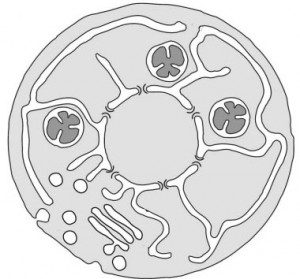
In collaboration with Buzz Baum (Cambridge University) I proposed the “inside-out” theory for the origin of eukaryotic cells in a 2014 paper. While I have contributed to a few reviews of this field, Buzz has become an expert on the cell biology of the Asgard Archaea – the closest related prokaryotes to the eukaryotic host cell.
Systematics and evolutionary theory
Throughout my career I have been interested in conceptual and methodological issues. This includes several papers on species concepts, where I lean towards a phylogenetic/genealogical view that species, like other taxa, are exclusive groups of contemporaneous organisms (i.e., groups of organisms that are more closely related to each other than to any organisms outside the group). To support this concept, I have proposed two measures of relatedness: concordance factors and exclusivity factors. Through collaborations with statistician colleagues, this conceptual work resulted in the development of some novel methods in phylogenetics, especially in relation to the study of genealogical discordance. Other areas of interest include the concepts of adaptation and homology.
Systematics/Phylogenetics
The lab has used molecular phylogenetics to study diverse groups of plants with a goal of addressing a diversity of evolutionary questions, such as morphological evolution, the evolution of plant-pollinator interactions, biogeography, rates of evolution, key innovations, hybridization, ring species, and species limits.
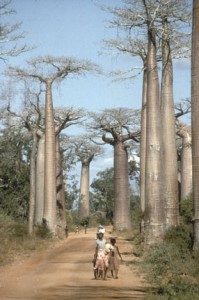
My most sustained interest has been in the evolution baobabs (genus Adansonia): I did my dissertation on the pollination biology and systematics of baobabs focusing on the species endemic to Madagascar. A former graduate student, Nisa Karimi, has continued working on this group with several papers, which have collectively shed great light on the evolutionary history of these magnificent plants.
Moving out from Adansonia, my lab has published several papers on the broad scale phylogeny of Malvaceae, with a special focus on the bombacoid clade. Historically this work was led by a former post-doc and collaborator, Bil Alverson and has benefitted greatly from collaborations with Jonathan Wendel’s lab. Other former lab members remain active in Malvaceae research, most notably Maggie Hanes and Barbara Whitlock.
Several systematic projects were developed by students or post-docs, who continues that work after leaving the lab. Examples of plant groups studied, included Thalictrum (Ranunculaceae), Iochroma (Solanaceae), Scaevola (Goodeniaceae), and Euphorbia (Euphorbiaceae). For more details visit my former lab members’ websites.
Evolutionary Developmental Genetics (Evo-Devo)
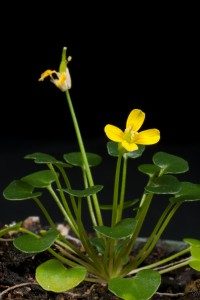
A long-standing interest in my lab was to identify genes underlying species differences. We used developmental genetic knowledge from model species to guide studies of several different traits in different plant groups. In many cases, projects started in my lab were taken forward by former graduate students or post-docs in their own independent labs. We studied a diversity of plant phenotypes and used many experimental approach including, in situ hybridization, immunolocalization, qPCR, and plant transformation. We also developed a new approach, transgenomics, which entails making a genomic library from a donor species and introducing this into a recipient species’ genome by high-throughput transformation.
Evolutionary education
As a committed educator, I have long had an interest in improving the teaching of evolution. My main contributions have been in relation to tree thinking, the ability to use evolutionary tree diagrams to think and communicate clearly about evolution. With collaborators, especially by former graduate student, Stacey Smith, I contributed to an influential opinion paper, a validated test of tree thinking, and a textbook of phylogenetic biology.