Evolutionary Chemistry and Origins of Life
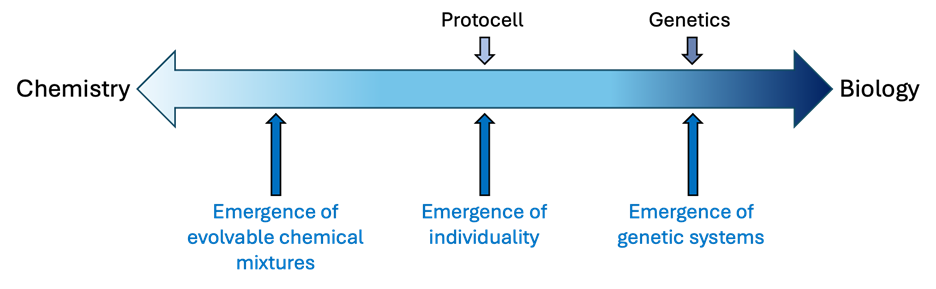
Our research is structured around the idea that the origin of life, can be seen as a general phenomenon that occurs when chemical ensembles in spatially structured environments have certain properties. Most important, the underlying chemistry must allow some autocatalysis so that ensembles can shift among alternative locally-stable stable states. This chemical evolution can occur even when ensembles are little more than patches in the environment and when autocatalysis depends on mechanisms other than template-replications of genetic polymers. The Baum lab uses innovative empirical and computational research to test the model (see figure). We aim to clarify conditions allowing chemical evolution to arise and to map out the process by which simple chemical evolution can eventually yield features needed for biological (Darwinian) evolution: self-bounded ensembles (individuals) and template-replicating genetic polymers.
1) Emergence of evolvable chemical mixtures
The theory we have developed suggests that out-of-equilibrium small molecule chemical mixtures can undergo long term changes in composition that resemble those seen in ecology or evolution. We conduct diverse laboratory experiments to look for evidence of these phenomena.
Mathematical1 and computational investigations2 show that chemical reaction networks are huge and include within them uncountably many autocatalytic cycles. These cycles can interact with each other much like species in biological ecosystems3 implying that dynamics of prebiotic chemical mixtures might have resembled ecological succession4.
Our basic approach is to study the behavior of prebiotic soups – mixtures of compounds that are to some degree likely to have existed before life5. We incubate periodic soups (usually minerals) and use periodic dilution-and-replenishment to keep systems out of equilibrium. We original implemented this strategy, chemical ecosystem selection6, while tracking simple chemical features, which revealed evidence of complex non-linear chemistry7. We now use high-sensitivity liquid chromatography and tandem mass spectrometry (LC-MS) to obtain extremely detailed characterization of chemical dynamics and allow inferences regarding the underlying chemical reaction network. Current work8 is following up on preliminary evidence of heritability in the absence of genes and testing the hypothesis that small molecule combinatorial chemistry tends to multi-stability and extreme sensitivity to chemical perturbations.
2) Emergence of individuality
One of the most obvious features of life is that chemical ensembles are bounded intrinsically: they make their own edges. This allows for a growth-and-division lifecycle that, among things, promotes cooperation among cellular components and suppresses cheating. We conduct computation and experimental research to better understand how individuation first arose and how primitive protocells might have evolved even in the absence of genes.
Our computational research is motivated by the cells-as-propagules hypothesis9, which proposes that, in environments subject to turnover in available sites, ecosystems chemical propagules composed capable of co-dispersing multiple cooperating autocatalytic cycles might be expected to arise and gradually acquire autonomy. We have shown that, in spatially structured environments, dispersal is an important consideration10. Now, partly in collaboration with Emily Dolson at Michigan State University, we are starting to model diverse mechanisms of co-dispersal assess whether protocells could gradually evolve rather than just pop into existence ready to grow and divide, as usually assumed. On the experimental front, graduate student Tymofii Sokolskyi is studying heritability in populations of artificial protocells as indicated by temporal dynamics11 and responses to artificial selection12.
3) Emergence of genetic systems
Modern life depends on sets of polymers (proteins and nucleic acids) that cooperate to enable cells to grow and divide. By catalyzing specific reactions, polymers direct flux through metabolism and into the generation of new polymers. Moreover, nucleic acids have a specific ability to catalyze the formation of complementary strands, which serves as the basis for genetic inheritance. We are using experiments and computational modeling to understand how communities of cooperating polymers can emerge and complexify.
With collaborator, John Yin, we have used recursive wet-dry cycling (with dilution and replenishment) to elicit polymer formation and look for evidence of autocatalytic feedback. These investigations are at an early stage but could shed light on the intrinsic dynamics of polymerization cascaded. This work is complemented by a new experimental approach we are developing with support from the Alfred P. Sloan foundation. In a collaboration with David Beebe, a microfluidics engineer, we impose artificial selection on the emergent properties of droplets containing polymer populations. Combined with mathematical analysis of abstract polymerization systems13 and computational modeling of ecosystems of cooperating, catalytic nucleic acids14 we believe we will better understand how complex genetic systems composed of many long and highly efficient polymers can bootstrap themselves into existence during origins of life.
1 Gagrani et al. 2024; Gagrani and Baum 2025
2 Peng et al. 2022
3 Peng et al. 2020
4 Baum et al. 2023
5 Vincent et al. 2022
6 Baum and Vetsigian 2016
7 Vincent et al. 2019
8 Sokolskyi et al. 2024
9 Baum 2015
10 Plum et al. 2025
11 Sokolskyi et al. 2023
12 Sokolskyi et al. 2026
13 Gagrani and Baum 2025
14 Peng et al. 2026
Origins of life and eukaryogenesis publications from the Baum lab (for other publications see Google Scholar)
Anderson, N. and Baum, D. A. 2026. Selection for propagule formation in prebiotic chemical ecosystems. biorXiv 2026.09.08.750225; https://doi.org/10.64898/2026.09.08.750225
Baum, D. A., 2026. A tidy story for a messy beginning. Review of: The Origins of Life: From Abiotic Chemicals to the First Cells, by Karl J. Niklas, Thomas, G. Owens, and Randy Wayne. Bioscience. In press.
Peng, Z., Spencer, E. and Baum, D. A. 2026. The diverse effects of side reactions on the persistence of autocatalytic cycles. Journal of the Royal Society Interface. In press. (preprint: https://doi.org/10.26434/chemrxiv-2025-nv8qg)
Peng, Z., Plum, A. M., Kartha, R., Jacobson, E. M., and Baum, D. A. 2026. Conditions enabling the persistence of cooperating ribozymes without cellular encapsulation. Journal of Molecular Evolution 94(3) https://doi.org/10.1007/s00239-026-10323-6
Sokolskyi, T. and Baum, D. A. 2026. Vesicle populations can respond to selection for greater turbidity via emergent cooperative dynamics. ACS Langmuir. https://doi.org/10.1021/acs.langmuir.6c00275
Gagrani, P. and Baum, D. A. 2025. Evolution of complexity and the origins of biochemical life. Physical Reviews E 111: 064403. https://doi.org/10.1103/PhysRevE.111.064403
Plum, A., Kempes, C. and Baum, D. A. 2025. Spatial Structure Supports Diversity in Prebiotic Autocatalytic Chemical Ecosystems. npj Complexity: 2, 21. https://doi.org/10.1038/s44260-025-00045-z
Sokolskyi, T., Cuevas-Zuviria, B., Gargulak, S., Allen, E., & Baum, D. A. 2024. Measuring heritability in messy prebiotic chemical systems. bioRxiv 2024.08.03.606486; https://doi.org/10.1101/2024.08.03.606486
Sokolskyi, T., Ganju, P., Montgomery-Taylor, R., Baum, D. A. 2024. Evidence of heritability in prebiotically realistic membrane-bound systems. Life 14:284. https://doi.org/10.3390/life14030284
Gagrani, P., Blanco, V., Smith, E. and Baum, D. A. 2024. Polyhedral geometry and combinatorics of an autocatalytic ecosystem. Journal of Mathematical Chemistry, 62(5), 1012-1078. https://link.springer.com/article/10.1007/s10910-024-01576-x
Baum, D. A., Peng, Z., Dolson, E., Smith, D. E., Plum, A. M., and Gagrani, P. 2023. The ecology-evolution continuum and the origin of life. Journal of the Royal Society Interface 20(208). https://dx.doi.org/10.1098/rsif.2023.0346
Foreback, M., Leither, S., Dolson, E. and Baum, D. A. 2023. The Role of Abiotic Parameters in the Promotion of Egalitarian Major Evolutionary Transitions. ALife 2023. MIT Press. In ALIFE 2023: Ghost in the Machine: Proceedings of the 2023 Artificial Life Conference. MIT Press. https://direct.mit.edu/isal/proceedings/isal/35/78/116809
Leither, S., Foreback, M., Dolson, E. and Baum, D. A. 2023. Interaction Strengths Affect Whether Ecological Networks Promote Egalitarian Major Transitions. In ALIFE 2023: Ghost in the Machine: Proceedings of the 2023 Artificial Life Conference. MIT Press. https://direct.mit.edu/isal/proceedings/isal/35/73/116913
Peng, Z., Linderoth, J., Baum, D. A. 2022. The hierarchical organization of autocatalytic reaction networks and its relevance to the origin of life. PLoS Computational Biology 18(9): e1010498. https://doi.org/10.1371/journal.pcbi.1010498
Vincent, L., Colón-Santos, S., Henderson J. Cleaves II, Baum, D. A.*, Maurer, S. E. * [co-corresponding author] 2021. The Prebiotic Kitchen: A Guide to Composing Prebiotic Soup Recipes to Test Origins of Life Hypotheses. Life 11(11): 1221 [link].
Dey, G, Baum, D. A., and Baum, B. 2020. Origin of Eukaryotes. Oxford Bibliographies in Evolutionary Biology (Ed. Karin Pfennig). New York: Oxford University Press [link]
Baum, B. and Baum, D. A. 2020. The merger that made us. BMC Biology [link]
Peng, Z., Plum, A., Gagrani, P., and Baum, D. A. 2020. An ecological framework for the analysis of prebiotic chemical reaction networks. J. Theoretical Biology 507:1-15 https://doi.org/10.1016/j.jtbi.2020.110451
Vincent, L., Berg, M., Krismer, M., Saghafi, S., Cosby, J., Sankari, T., Vetsigian, K., Cleaves, H. J. III, and Baum, D. A. 2019. Chemical Ecosystem Selection on Mineral Surfaces Reveals long-term dynamics consistent with the spontaneous emergence of mutual catalysis. Life. 9(4), doi:10.3390/life9040080 [link]
Mizuuchi, R., Blokhuis, A., Vincent, L., Nghe, P., Lehman, N., and Baum, D. A. 2019. Mineral surfaces select for longer RNA molecules. Chemical Communications
10.1039/C8CC10319D [link]
Vincent L., Cleaves H. J., and Baum, D. A. 2019. A candidate self-propagating system enriched by chemical ecosystem selection. ALIFE 2019: The 2019 Conference on Artificial Life, Artificial Life, 658-659. [link]
Vincent L., Vetsigian K., and Baum, D. A. 2018. Chemical ecosystem selection approach for generating evolvable chemical systems in vitro. In: Artificial Life Conference Proceedings 2018 Jul (pp. 649-650). MIT Press, Cambridge, MA. [link]
Baum, D. A. 2018. The origin and early evolution of life in chemical complexity space. Journal of Theoretical Biology. 456: 295-304 [https://doi.org/10.1016/j.jtbi.2018.08.016]
Dey, G, and Baum, D. A. 2018. Origin of Eukaryotes. Oxford Bibliographies in Evolutionary Biology (Ed. Karin Pfennig). New York: Oxford University Press. DOI: 10.1093/OBO/9780199941728-0108 [link]
Baum, D. A. and Lehman, N. 2017. Life’s late digital revolution and why it matters for the study of the origins of life. Life 7(3), 34: doi: 10.3390/life7030034 [link]
Baum, D. A. and K. Vetsigian. 2017. An experimental framework for generating evolvable chemical systems in the laboratory. Origins of Life and Evolution of Biospheres, 47:481–497. https://link.springer.com/article/10.1007/s11084-016-9526-x
Baum, D. A. 2015. A comparison of autogenous theories for the origin of eukaryotic cells. American Journal of Botany. 102(12): 1-12 [link]
Baum, D. A. 2015. Selection and the origin of cells. Bioscience 65: 678-684. https://doi.org/10.1093/biosci/biv063
Baum, D. A. and Baum, B. 2015. We’ve got the evolution of complex cells inside-out. New Scientist. 3008: 28-29.
Baum, D. A. and Baum, B. 2014. An inside-out origin of the eukaryotic cell. BMC Biology 12:76. https://doi.org/10.1186/s12915-014-0076-2